

Not Every Soulmate Is a Husband: The Women Who Know You Best
Not every soulmate is a husband. Some of them split the fries with you at two in the morning and know your childhood lore by heart. Some of them have watched you fall in love with the wrong person and were still standing there when you finally got it right. Some of them have been carrying pieces of you since before you knew what you were becoming.
These are the great loves that nobody writes songs about. The female friendship soulmates. The women who did not appear on the day you walked down an aisle, but who were there long before it, and will be there long after everything else in your life has changed shape.
The Friendships That Predate Everything Else
Not Every Soulmate Is a Husband
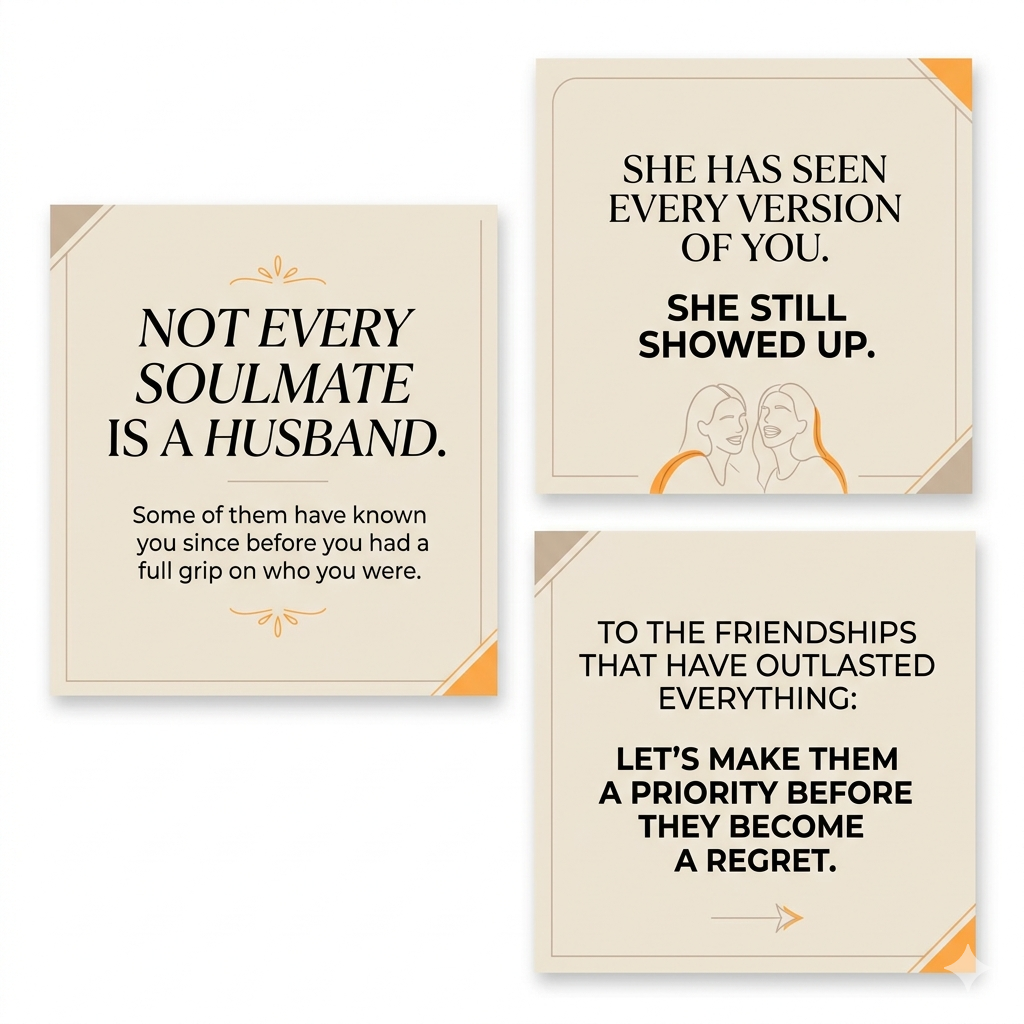
Not every soulmate is a husband. Some of them have known you since before you had a full grip on who you were.
There is a particular kind of woman in your life. Not your colleague, not your neighbour, not the friend you made because your children ended up in the same class. The one who knew you before you had a title, before the identity you now carry so naturally had fully formed.
She does not just remember you. She holds you. There is a specific quality of being known that only comes from time, from having been present before the role arrived, before the competent adult version was the only version anyone ever saw. She knows the weight of what came before the performance. She has been carrying it alongside you.
This is what deep female friendship holds that nothing else can replicate. Not catching up, because she was never out of the loop on who you are, even when life has kept you apart. Not being known in your current chapter, but being known across all of them. The whole arc. Not just who you became, but what it cost to get here.
These friendships deserve more than a voice note once a year. More than a birthday post that says: thinking of you, we really need to catch up.
What Do These Women Know About You That Most People Never Will?
What These Women Know About You That Most People Never Will
She Has Known You Since Before the Role Took Over
A partner knows you in the context of your shared life. Your children, your home, the version of yourself that existed from the moment they arrived in it. They know the adult you. The formed you. The you who has made certain choices and become those choices.
Your oldest women know something different and something older. They know your laugh, the real one, the one that happens before you can decide whether to let it. They know the story before it was edited into something presentable. They saw the earlier drafts, the crossings-out, the margin notes, the versions of you that never made it into the final copy. They were there when the manuscript was being written, not just when it was published.
And what that level of knowing gives you, the thing that nothing else in your life quite replicates, is the permission to be unedited. To be unpolished and unperforming and uncertain without it reading as something to be fixed. She has seen you at your most unfinished and she showed up anyway. That is not just love. That is the specific, irreplaceable freedom of a friendship that has gone the distance.
She knows why you are the way you are. Not because you explained it. Because she was there when it was being made.
She has seen every version of you. She still showed up.
Why Adult Female Friendship Is One of the Hardest Things to Maintain
Life Filled. Then Overfilled. Here Is What the Research Says.
Something shifts in the middle of life. The friendships that once existed in the oxygen of proximity, the same city, the same building, the gravitational pull of shared geography, now exist in the narrow gaps between everything else. The school run. The project. The other project. The thing you promised you would do this weekend and then did not do.
It is not that you stopped wanting it. It is that wanting something and making it happen have become two completely different things.
The data confirms what she already knows in her body. According to the 2025 Women's Agenda Ambitions Report, published with AGSM UNSW, 72 per cent of Australian women reported burnout in the past twelve months. Working mothers are 28 per cent more likely to experience burnout than working fathers.
These are not abstract findings.
They are the backdrop against which every deferral of the group chat trip takes place. The friendship is not the thing that needs to be managed better. The friendship is the thing that has been quietly making way for everything else.
And across multiple longitudinal studies of social connection and health outcomes, strong social ties have been found to increase the likelihood of living longer by up to 50 per cent. Not a wellness statistic. A statement about what this kind of connection is actually worth.
Life Survival Kit: Food. Water. Time with your girls.
The third item is not optional. The research has been saying so, at length, for decades. She has been treating it as optional for years.
You did not mean to drift. None of the women in any of these friendships meant to drift. The group chat that has gone quiet since last Christmas does not represent a choice anyone consciously made. It represents the specific weight of a life that keeps asking for one more thing, and the friendship that keeps quietly stepping aside to let it pass. She is also, like everyone in this conversation, living her life for the first time. She got occupied with a life she is also navigating for the first time. The friendship stepped aside to make room. That is not a failing. But it is a cost.
What happens is subtler than a decision. Life fills. Then overfills. The calls get shorter, then sporadic, then mostly birthday posts and a reaction emoji on something she shared. The plans get made and cancelled and made again. The gap becomes something you both acknowledge in shorthand: we really need to do this properly.
And the longer it sits, the more charged it becomes. Not because anything is wrong. Because something is quietly right, and you both know it is being left in the cupboard.
She was there before the kids, before the mortgage, before the identity shift. She deserves more than a catch-up that keeps getting rescheduled.
The Specific Grief of a Friendship That Quietly Fades
When Something Sacred Gets Left in the Cupboard
There is no word for the grief of losing a friendship to time. Not to a fight, not to a falling out. Just to the slow accumulation of postponed plans and unreturned calls until one day you realise you are not quite sure when you last properly talked.
It is not the dramatic grief of a rupture. It is quieter than that. More ambiguous. You still love her. She still loves you. And somehow that is not, by itself, enough to make the thing actually happen.
This kind of grief does not get named very often. It probably should. It is one of the most common forms of loss in adult women's lives, and one of the least publicly acknowledged. The friendship that faded not because anyone wanted it to, but because life kept asking for one more thing and the friendship was the thing that moved itself quietly out of the way.
The woman in her early sixties who looks at a friendship that has been in the planning stage for four years knows this grief with a precision that no younger version of herself could quite access.
For her, the drift is not eighteen months. It is four years, sometimes more, of a friendship that both women still reference as one of the most important in their lives. And the 70th birthday that gathers six women who have known each other since their twenties is not just a celebration. It is an acknowledgement, urgent and overdue, that getting to be together, in a room, all at once, is not something to do quietly. It deserves more ceremony than any birthday before it.
The friendships that hold the parts of you that no one else sees are not the ones designed to disappear. They are the ones that require a decision.
To the friendships that have outlasted everything:
Let's make them A Priority before they become a regret.
Naming what this is, the quiet cost of a friendship left unchosen, is the first part of the decision. The second part is smaller than it feels.
Not every soulmate is a husband. Some of them have known you since before you had a full grip on who you were.
Why This Gets The Yes Instantly
Deliberate looks like a date in the calendar. An actual date. Not a maybe in the group chat, not a let's try for next term, not a running thread of enthusiasm that peaks on a Thursday night and dies by the weekend.
It looks like one woman deciding the trip is going to happen and making it happen. It looks like everyone paying their own share so nobody is chasing anybody for anything. It looks like a curated package that already knows how the weekend should flow, so the woman who usually carries the admin arrives as a guest instead.
It looks like a Sunday night on the way home when she is quieter than she was on Friday, but quieter in the way of someone who has put something back.
She came home like herself again.
That is not a small thing. That is the whole thing.
The version of this that actually works looks like a single phone call. You describe your group, where you are going, and what this weekend needs to feel like. A long table dinner in Melbourne with everything the city does well. A coastal escape on the Gold Coast, two days that belong entirely to the women in the room. Brisbane if she has never been and you have wanted to show her what the city has become. A consultant who has designed weekends like this for fifteen years matches you to the right package. A date goes in the diary.
The part that this article kept circling around, who pays, who chases, who carries the weight of the weekend before it begins, is already resolved. Per-person pricing means every woman in the group pays her own share directly. Nobody fronts the cost. The organiser does not send the awkward follow-up message. The money conversation disappears before it starts.
And the woman who always makes things happen for everyone else, the one who has been quietly carrying this trip since the idea first appeared in the group chat, the one who arrives to every gathering already a little depleted from the work of making it possible, she gets to arrive at this one as a guest. Not the logistics manager. Not the person with the notification still open. A participant. Someone to whom this weekend is also happening.
What to Know Before You Book
A girls trip does not need a special occasion to be worth booking. The long-overdue catch-up is reason enough. All five eras are available across Melbourne, Sydney, Brisbane, and the Gold Coast: Girls Weekend, Milestone Celebration, Mumcation, Fresh Start, and Switch Off. Group size does not need to be confirmed before the first conversation. The right time to book is before another year does what the last one did.
My Ultimate Girls Trip Perspective
My Ultimate Girls Trip is built around five eras, not because women's lives fit neatly into categories, but because the right framing makes the decision feel obvious instead of overwhelming.
A Girls Weekend for the friendships that are long overdue a proper gathering.
A Milestone Celebration for the birthday that deserves more than dinner.
A Mumcation for the mothers who need their women and know it. A Fresh Start for the one whose next chapter begins this weekend.
A Switch Off for everyone who has been the infrastructure for too long.
One phone call. Per-person pricing so nobody chases anybody for money. The organiser arrives as a guest. The trip that has been in the group chat long enough: this is how it leaves.
Final Takeaway
There Are Women You Will Still Want Beside You When You Are Ninety
There are women you will still want beside you when you are ninety. Not because they are useful. Not because your lives happened to run in parallel for long enough to create a habit. Because they are the keepers of the original. Because being in the room with them does something that nobody else can replicate. Because they remember who you were before you became so many things to so many people, and that memory is its own kind of permission.
The woman who is sixty-two and looking at a friendship she has been meaning to honour properly for three years knows the weight of this with a particular clarity. The woman turning seventy, gathering around her the five or six people who have been there since the beginning, understands that this is not a birthday party. It is a marking. The 70th that gets done properly, the one that gives the occasion the ceremony it has always deserved, becomes the weekend they are still talking about in ten years. The 60th that finally happens, after years of almost-booking and we-should-do-something, becomes the proof that the friendship is worth the same quality of attention it has always given her.
The women who raise each other do not stop being each other's people once life gets serious. They become more essential. The older the friendship, the scarcer the time, the more sacred the gathering.
These women deserve a proper occasion. Not another dinner that gets squeezed between school holidays and work travel and someone's renovation. A proper thing. Something worth planning and worth remembering. Something that says: I know what this is. I know what we are to each other. And I made a thing of it.
Frequently Asked Questions
Why are female friendships so important?
Female friendships carry a type of knowing that neither romantic relationships nor family relationships can replicate. The women who have known you across time hold the original version, the earlier drafts, the uncertain years, the parts of you that predate the roles you now occupy. Research consistently supports what women have already known in their own experience: strong social bonds with other women are linked to longer life, lower rates of burnout and depression, and better health outcomes across the decades. According to the 2025 Women's Agenda Ambitions Report and AGSM UNSW, 72 per cent of Australian women reported burnout in the past twelve months. Longitudinal research has consistently found that strong social ties increase the likelihood of living longer by up to 50 per cent. The importance of female friendship is not sentimental. It is structural.
What is the value of female friendship in adult life?
In adult life, female friendship often becomes hardest to maintain at precisely the point where it matters most. Longitudinal research has consistently found that strong social ties increase the likelihood of living longer by up to 50 per cent. The women who know your laugh, your history, and the version of you that existed before the current chapter are not a luxury category of your life. They are one of the most important things in it. The value is emotional, relational, and, according to the growing body of research, biological.
What are female friendship soulmates?
A female friendship soulmate is the woman who knew you before your current identity fully formed. She saw the early drafts. She was there for the uncertain years, the loud mistakes, the quiet survivals. She does not just love the person you became. She carries the memory of the person who was becoming. Not every great love story in a woman's life is romantic. Some of the deepest ones are friendships of this specific, irreplaceable kind.
Why do deep female friendships fade in adulthood?
They fade not because they stop mattering but because maintaining them requires deliberate, calendar-level priority that the middle of life rarely creates automatically. The group chat says yes. Nobody locks it in. Another year passes. The answer is not more intention. It is one action: set the date. Actually set it.
How do you make time for female friendships when life is full?
You make it the same way you make time for anything that matters: you put it in the calendar before life fills the space. A curated group getaway removes the single biggest barrier, the mental load of making joy happen. When the package already knows how the weekend should flow, and when each woman pays her own share directly, the organiser does not have to carry it. She books it and then arrives as a participant, not a logistics manager. One phone call. A date in the diary. Done.